

Every time you ship a product, you balance two competing priorities — preventing damage and minimizing shipping costs. Getting it wrong means paying dimensional weight fees on oversized boxes or dealing with costly returns from damaged goods.
The challenge becomes even more complex when you factor in protective materials like bubble wrap, foam inserts or void fill. How much padding do you need? What if your irregularly shaped product doesn’t fit neatly into standard box dimensions? And how do you account for the “dead space” that drives up carrier fees without adding value?
This guide provides a shipping box size chart and formulas for measuring accurately while accounting for protective materials. By the end, you’ll have a framework that saves you money on shipping costs while ensuring your products arrive safely every time.
If you want to protect your profit margins while maintaining product quality and brand reputation, you need to make an informed decision about your packaging.
Selecting an appropriately sized shipping box affects your bottom line in three critical ways:
DIM weight pricing changed how carriers charge for shipments by shifting the focus from weight to space. Instead of billing solely on actual weight, carriers calculate how much room your package occupies in their trucks and planes and charge accordingly.
To see why this matters, imagine shipping two 5‑pound items — a compact dumbbell measuring 8 by 4 inches and a pillow measuring 20 by 20 inches. They weigh the same, but the pillow consumes far more space. Under DIM weight pricing, you’ll pay significantly more to ship the pillow because carriers charge for the volume it occupies, not just its weight.
UPS, FedEx and USPS apply DIM weight to most shipments. And with last‑mile delivery accounting for over 53% of total shipping costs, minimizing wasted space becomes essential for profitability. Even a slightly oversized box can push you into a higher DIM bracket and erode your margins.
Product damage directly impacts your bottom line through return processing costs, replacement inventory and lost revenue. More importantly, it erodes customer trust. When buyers receive damaged goods, they may question your quality standards and hesitate to order again.
Implementing protective strategies starts with selecting boxes that fit your products properly and allow just enough room for cushioning materials.
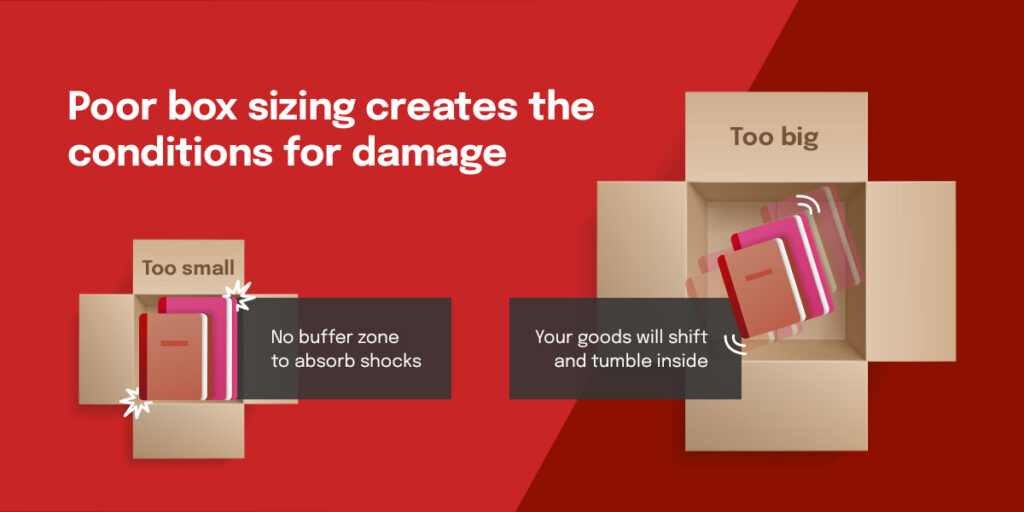
Poor box sizing creates the conditions for damage in two equally problematic ways.
Oversized boxes are wasteful in two ways. Financially, you’re paying for excess corrugated material and the void fill needed to stabilize products in an unnecessarily large container. Every inch of extra space forces you to spend money on materials that add no value to your shipment.
Packaging waste’s environmental impact will continue to be a concern as e-commerce expands. While corrugated cardboard is a renewable and recyclable material, oversized boxes can negate its environmental advantage. Transportation adds to a package’s carbon footprint, and emissions are highly sensitive to weight. A 2023 study found that if cardboard packaging were 12% lighter, its total emissions would have matched those of a lighter alternative. Even a small amount of unnecessary material significantly increases environmental impact.
Awareness of sustainability issues continues to climb. In 2025, 77% of U.S. consumers described a package’s recyclability as “extremely” or “very” important to them. When your customers must hunt through piles of void fill material to find tiny items packed in oversized boxes, they’ll notice. Right-sizing reduces material waste, lowers shipping costs and demonstrates environmental responsibility to your customers.
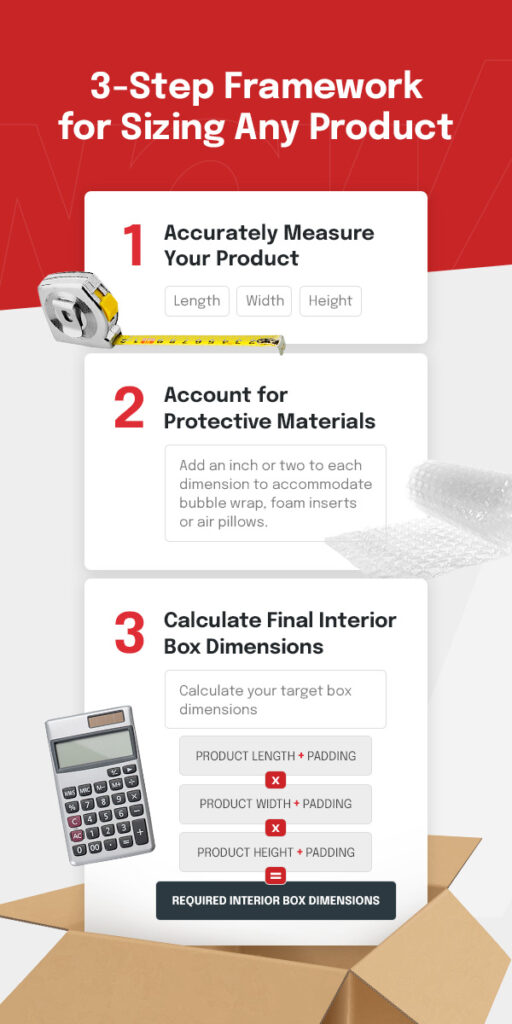
Following a systematic measurement process is the most reliable way to select appropriate shipping box sizes. These three steps work for any product, regardless of shape, size or fragility. By measuring accurately, accounting for protection and calculating final dimensions, you’ll determine what box dimensions you need before comparing options or placing orders.
Start by measuring your product’s three dimensions with a tape measure or ruler. Accurate measurement at this stage prevents costly mistakes later. A miscalculation of a fraction of an inch in one dimension can push you into the next standard box size up, triggering higher DIM weight charges.
Follow these steps to measure correctly.
Your product’s dimensions are only the starting point. Every shipment requires protective materials between the product and the box walls to absorb impact during handling, depending on product fragility, weight and value.
For most standard products, add an inch or two to each dimension to accommodate bubble wrap, foam inserts or air pillows. Fragile items like glassware or electronics may require a few extra inches of cushioning on all sides. Strength is more applicable than padding for heavy products, which need durable corrugated boxes to support the weight without failing structurally.
The type of protection you use also depends on the box’s strength and the corrugated material specifications. Heavier items require higher burst strength ratings and thicker corrugated board construction.
With your product measurements and padding requirements established, calculate your target box dimensions using this formula — (product length + padding) x (product width + padding) x (product height + padding) = required interior box dimensions.
For example, if your product measures 10 by 8 by 6 inches and you need 2 inches of padding on each side, your calculation would be (10 + 4) x (8 + 4) x (6 + 4) = 14 x 12 x 10 inches. Note that you add padding to both sides of each dimension, so 2 inches of padding adds 4 inches to that measurement.
Use these measurements to compare against standard shipping box sizes or to specify custom corrugated box sizes that fit your exact requirements. Keep these dimensions readily available as you evaluate your packaging options.
Once you’ve calculated your ideal interior dimensions, you can evaluate whether standard off-the-shelf boxes meet your needs. Standard boxes offer the advantage of immediate availability and predictable pricing, but they work most efficiently when your product dimensions closely match common box sizes. Understanding your options and their pricing structures helps you determine when they’re cost-effective and when custom solutions deliver better value.
| Box Size | Cubic Inches | POTENTIAL Uses |
|---|---|---|
| 6 by 6 by 6 inches | 216 | Small products, cosmetics and accessories |
| 8 by 6 by 4 inches | 192 | Books, apparel and small electronics |
| 10 by 8 by 6 inches | 480 | Shoes, medium electronics and kitchen items |
| 12 by 12 by 8 inches | 1,152 | Multi-item kits, subscription boxes and larger products |
| 16 by 12 by 12 inches | 2,304 | Bulk products, multiple items and large electronics |
| 18 by 18 by 16 inches | 5,184 | Very large items, furniture components and bulk shipments |
| 20 by 20 by 20 inches | 8,000 | Oversized products, industrial items and large assemblies |
An off-the-shelf box may be the most economical solution when your calculated dimensions fall close to one of these standard sizes. However, even a tiny variance in one dimension can result in wasted internal space and higher carrier fees.
Carrier flat-rate boxes from USPS, UPS and FedEx offer an alternative pricing model. Instead of calculating costs based on DIM weight, flat-rate pricing charges a fixed fee if your shipment fits within the carrier’s box and stays under the maximum weight limits.
Flat-rate boxes work exceptionally well for heavy items with small footprints. If you’re shipping dense products like metal components, tools or books that weigh several pounds but fit in a small flat-rate container, you’ll often pay less than standard DIM weight pricing. The predictable cost also simplifies budgeting and pricing calculations.
However, flat-rate boxes have significant limitations. The carrier’s available dimensions may not align with your product’s needs, and it typically costs more to ship lightweight items at a flat rate than it does to use standard shipping. Additionally, this option locks you into using your chosen carrier’s branded boxes instead of yours.
Stock box sizes are inefficient for many products. While off-the-shelf boxes work well for items that coincidentally match standard dimensions, they become problematic when your products fall between preset sizes or have unusual shapes. Understanding when standard sizing fails helps you identify opportunities where custom corrugated box sizes deliver measurable cost savings and better product protection.
Oddly shaped products expose the fundamental limitations of standard boxes. Shipping products that fall between standard sizes or have unusual shapes forces you to choose oversized containers that contain mostly air.
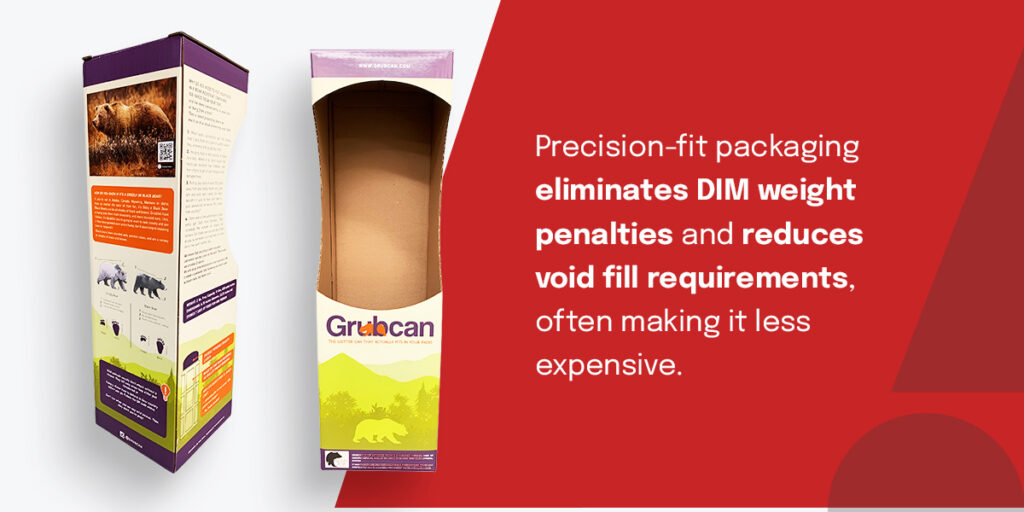
Custom shipping box sizes cost more per unit than standard off-the-shelf options, leading many businesses to default to standard sizing without doing the math. However, precision-fit packaging eliminates DIM weight penalties and reduces void fill requirements, often making it less expensive.
Calculate the break-even point by comparing total costs. Start with a standard box solution by adding the box cost, void fill materials and the DIM weight shipping charge. Then, compare that to a custom box, where you’ll pay more for the container but save on void fill and shipping due to its tighter dimensions. In many cases, the custom box’s lower shipping cost more than offsets its higher material cost.
The savings become even more compelling at volume. If you ship hundreds or thousands of units monthly, even saving $1 per shipment through better DIM weight pricing adds up to substantial annual savings. It’s an investment in efficiency — paying for what you need instead of air.
Even when you follow these guidelines, you’ll find not all products fit efficiently into standard box sizes. Irregularly shaped items, multi-product kits and fragile goods often require precision-fit packaging to eliminate wasted space and avoid DIM weight penalties. That’s why custom boxes are a strategic advantage.
Custom Boxes Now specializes in creating boxes engineered to your exact specifications. With over 60 years of industry experience, we offer multiple strength options, printing capabilities and fast turnaround times to meet your business needs. Our in-house structural design team ensures your products fit perfectly, reducing shipping costs and protecting your brand reputation with every order.
When you’re ready to stop overpaying for air, use our online box builder to input the dimensions you calculated in this guide and see how a custom solution can save you money. Interested in branded packaging? Explore our printing options to turn every shipment into a marketing opportunity. Contact us today to learn how we can help you ship smarter.


