

As we continue to embrace faster delivery and shipping methods to meet demand, it’s easy to overlook the associated risks. While the customer receives a quick shipment, there is still the chance of damaged products and a poor unboxing experience. Dimensional weight charges can be confusing, but it’s an integral part of modern commerce. It affects e-commerce enterprises, marketing agencies with product launch packaging requirements and brick-and-mortar businesses alike.
Knowing how to calculate dimensional weight and reduce it with the right-sized boxes is important. It’s the path not only to cutting shipping costs but also to properly protecting your product and improving the unboxing experience. Here’s everything you need to know about minimizing dimensional weight and why it matters.
DIM weight, also sometimes called volumetric weight, is a shipping pricing method. Carriers use the DIM weight to calculate shipping costs based on a package’s overall volume. When shipping packages, particularly for businesses, understanding dimensional weight is essential for managing spending and optimizing logistics:
All of these factors can increase or decrease business expenditures and environmental practices.
To understand shipping costs, it’s crucial to distinguish between a package’s actual weight and its DIM weight:
Carriers ultimately charge based on the greater of the two. This ensures they are fairly compensated for both the item’s weight and the space it occupies.
Consider the following examples:
Follow these straightforward steps for determining the dimensional weight of your boxes:
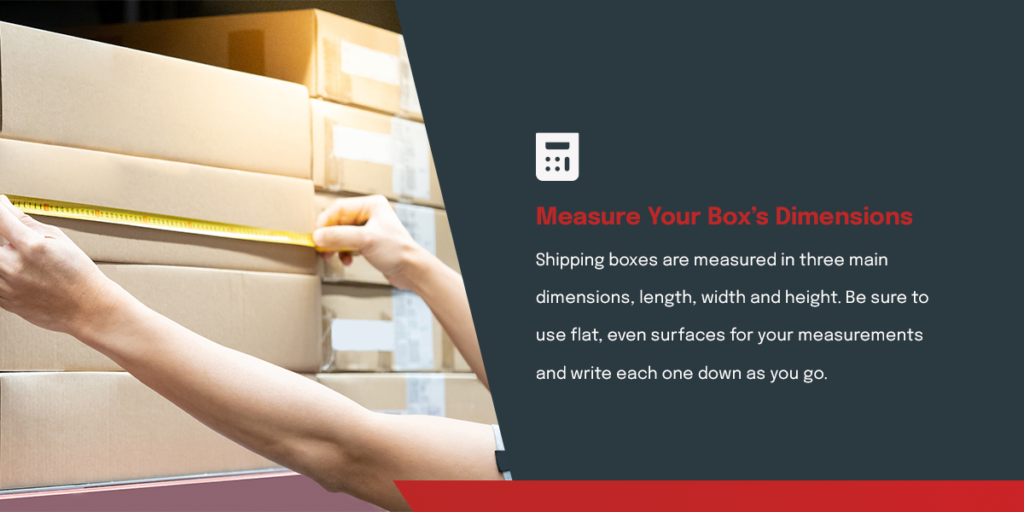
Shipping boxes are measured in three main dimensions, length, width and height. Be sure to use flat, even surfaces for your measurements and write each one down as you go. Use a single unit of measurement for consistency. U.S. shipments are typically measured in inches.
Measure the product and the box. Don’t include the flaps when measuring a flat box, but do measure the length, width and height of the finished box to get a precise external measurement.
The following are best practices for taking accurate measurements:
Multiply the length, width and height of the box to get its total volume.
Standard DIM measurements and weights are done in inches and pounds. It’s important to be aware of the current standard divisors used by major carriers. For example, UPS divisors include 166 for standard packages, 139 for daily rates and 166 for retail rates. For the United States Postal Service (USPS), the DIM divisor is 166 for both domestic and international packages over one cubic foot.
A lower divisor will result in a higher calculated dimensional weight for the same package volume, potentially leading to increased shipping costs. A higher divisor reduces the calculated dimensional weight. For example, a divisor of 139 will yield a higher DIM weight than a divisor of 166 for an identical package.
You might also encounter other common divisors, such as 194, particularly with domestic trucking carriers. Additionally, commercial shippers with significant volume may be able to negotiate a more favorable divisor directly with their carrier.
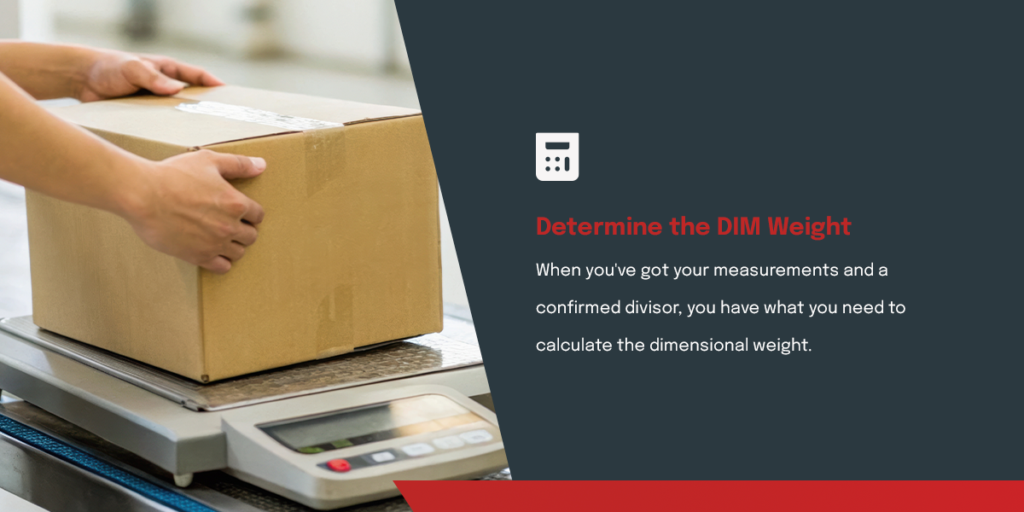
When you’ve got your measurements and a confirmed divisor, you have what you need to calculate the dimensional weight. This can be done using the following calculation:
Let’s say that you have a package that’s 50 inches long, 20 inches wide and 20 inches high. Multiplying these numbers would give you a total of 20,000. If you’re using UPS for a standard domestic package, you’d then divide this number by 166. You now have a total of 120.48, which you’d then round up to 121 pounds. You now have your DIM weight of 121.
It’s important to keep an eye out for any changes in divisor amounts, as they may change year to year.
The most effective way of reducing unnecessary DIM weight costs is to match the box size and product as closely as possible. The right-sized packaging ensures lower shipping costs and improved business practices by:
Optimizing packaging size also demonstrates a company-wide commitment to reducing negative environmental impacts in favor of more sustainable alternatives.
Custom Boxes Now has over 60 years of industry experience providing businesses with shipping box solutions that ensure product protection. We work with you as a structural design specialist to create a premium unboxing experience.
Our in-house capabilities have you covered, offering a wide and diverse range of printing methods, including digital, flexo and litho printing. This integrated method creates fast turnaround without sacrificing quality control, with an on-time delivery rate of over 99%.
Reach out today to one of our experts for your business’s packaging and shipping needs.


