

Have you ever audited your shipping invoices and wondered how lightweight shipments can result in such high fees? If items such as pillows and lampshades cost your business a fortune to ship, dimensional weight is the culprit. Since its inception in 2015, it has fundamentally changed shipping fees.
This guide breaks down DIM weight in shipping and how custom packaging can help you save on shipping fees. We’ll also provide a dimensional weight calculator to help you avoid surprises when planning your next shipment.
Dimensional weight is a pricing method UPS and FedEx adopted for ground shipments in 2015, reshaping shipping fee calculations. Instead of charging only for actual weight, carriers now factor in a package’s density, because lightweight, bulky items take up valuable space even when they don’t weigh much.
Before DIM weight, carriers routinely lost money transporting empty space in oversized or inefficiently packed boxes. Picture a truck filled with rugs, pillows, stuffed toys or T‑shirts. These products aren’t heavy, but bulky packaging limits how many shipments fit in a trailer and drives up transportation costs. DIM weight allows ensures carriers to receive compensation for the space those items occupy.
For e‑commerce brands and subscription box companies, this shift means:
Efficient packing is no longer optional if you want to protect your products without inflating your shipping bill. Even minor inefficiencies, such as choosing an oversized box or adding unnecessary void fill, can add the equivalent of three to four pounds to your billed weight. At scale, those extra charges will quietly erode your margins month after month.
Optimizing your packaging strategy starts with knowing the differences between the two numbers on every invoice. These factors distinguish DIM weight from actual weight and will help you understand your shipping costs better.
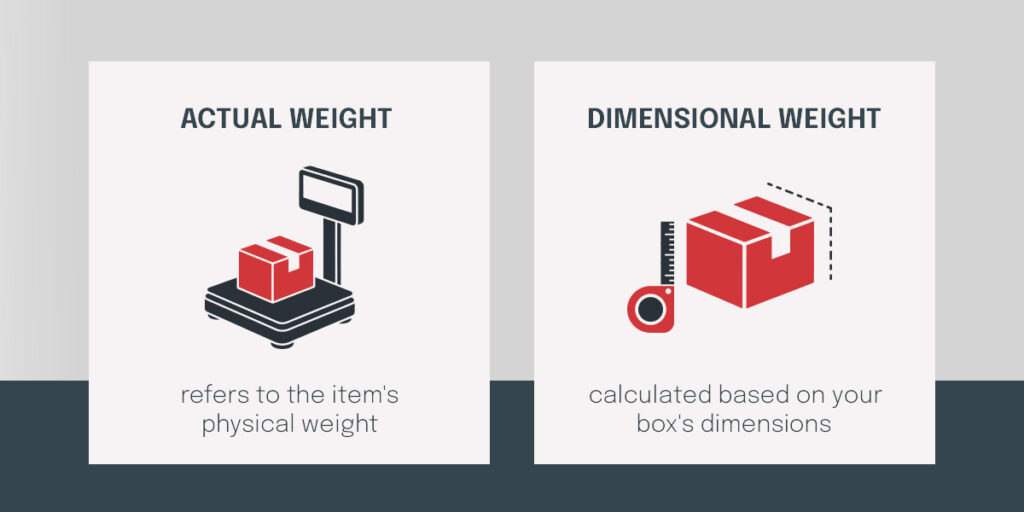
Carriers use whichever amount is higher to determine your billable weight. For our running shoes example, your carrier will use the DIM weight.
This principle also applies in the opposite direction. If you ship a 35-pound kettlebell in a 12-by-12-by-12 box, your carrier will charge you for the 35-pound actual weight because it exceeds the DIM weight.
Use the following DIM weight formula to understand how carriers arrive at this number for every item.
Importantly, current carrier rules require shipping carriers to round up to the nearest whole inch before multiplication. If your box’s dimensions are 12.1 by 12.1 by 12.1, round up to 13 by 13 by 13 before multiplying.
In practice, here is how this formula should look for a five-pound custom-made football helmet in a 12.1-by-12.1-by-12.1 box.
To simplify the process, you can use an online dimensional weight calculator that also accounts for the different shipping factors of various carriers. Just remember to round up your box’s dimensions to the nearest whole inch before putting them into the calculator!

Each carrier has a set DIM divisor, or a shipping factor used to calculate your DIM weight. Currently, FedEx and UPS tend to match each other’s DIM divisor to stay competitive, while USPS remains on the higher side. These numbers may change annually, but the ones in this guide are current standards as of 2026.
You must know the difference between the daily rate and the retail rate to know which applies to you.
FedEx uses the standard 139-inch DIM divisor for its ground, express and home delivery services. They also apply the same DIM weight formula of length times width times height and round up to the nearest whole number.
However, as of early 2026, FedEx has imposed an additional handling surcharge on top of the DIM rate for packages that exceed certain dimension thresholds, specifically items with a cubic volume greater than 10,368 cubic inches. Your packages with a lower actual weight can still incur an extra fee if boxes are larger than roughly a 22-inch cube. An oversize charge will apply to packages exceeding 17,280 cubic inches.
To master FedEx’s DIM weight calculation, imagine you’re shipping 10 vacuum-sealed queen-sized pillows that weigh 15 pounds total in a 24-by-24-by-24 box. By multiplying the dimensions and dividing the product by FedEx’s DIM divisor of 139, you get a vastly larger DIM weight of 100 pounds. In addition to paying based on your item’s DIM weight, you’ll also be responsible for an additional handling surcharge because your box is 13,824 cubic inches. Despite your item weighing only 15 pounds, your total bill will be substantially higher due to its bulky packaging.
For more information on FedEx’s fees, visit their shipping fees and rules page for the latest updates. You may also try out their DIM weight calculator for an accurate forecast of your final DIM weight.
Since UPS is FedEx’s closest competitor, it operates similarly. UPS uses a 139 DIM divisor and rounds up to the nearest whole inch before multiplication for all its domestic and international package services. They generally mirror FedEx’s rules on surcharges and additional fees, though specifics may vary as these numbers change regularly.
If you’re a high-volume shipper, you can negotiate for a lenient 166 DIM divisor with your rep. Because UPS is similar to FedEx, the process for calculating your DIM weight will follow the same steps as above.
For updated information on UPS’s exact fees, check their shipping costs and rates guide page for the current numbers.
Of the three leading characters, USPS has the most budget-friendly DIM factor of 166, which can translate into potentially lower fees and a lower billing weight if you ship light but bulky packages. However, USPS follows the same rule of rounding up to the next whole inch when calculating DIM weight. Fortunately, USPS doesn’t often apply DIM weight pricing under one cubic foot or 1,728 cubic inches in many ground and commercial shipments, though this may vary per ground parcel service, pricing category or local rules. They also don’t follow FedEx and UPS’s surcharge-heavy pricing model. Instead, USPS sticks close to its published base rates with smaller, specific add-on fees for oversized or nonstandard packages.
To calculate your package’s DIM weight for USPS, you need to follow the same process of measuring its dimensions, rounding up to the nearest whole inch, then multiplying the length by the width and height. Afterward, divide by 166 to arrive at your final DIM weight.
For complete information on USPS’s published fees, visit their price list page.
With the carrier-specific numbers clear, let’s now focus on why DIM weight is crucial to your margins. If you’re still confused about what DIM weight is and how it can impact your business, imagine shipping an order of two‑pound canned vegetables packed in a 12-by-12-by-12 box, using FedEx. Though your item only weighs two pounds, you’ll need to pay for 13 pounds of DIM weight — a 550% increase. This cost can wipe out a significant portion of your margin when multiplied across 100 orders.
Now, imagine the same scenario, but this time you put the canned vegetables in custom packaging that perfectly fits the shipment, eliminating unnecessary space and reducing DIM weight. Across 100 orders, you’re getting back a huge chunk of your margin and potentially turning a break-even shipment into a profitable one.
Carriers encourage businesses to use more efficient packing strategies in response to DIM weight. However, standard stock boxes rarely fit products perfectly, leaving empty space in every box that costs extra to ship.
Consider partnering with Custom Boxes Now if you want to start being more intelligent about packing. Whether you send pillows, motorcycle helmets or energy drinks, we engineer boxes that fit your product within 1/16th of an inch, reducing DIM weight and saving money.
Besides lowering shipping costs, custom packaging provides multiple other benefits.


Switch to Custom Boxes Now to reduce your products’ DIM weight and save money, while standing out from your competition and contributing to a more sustainable world. With a proven track record and over 60 years of experience, we deliver unparalleled quality custom packaging solutions to a wide range of brands.
Our design and manufacturing process takes place under one roof, ensuring consistent quality throughout. Our in-house Build Your Box tool gives you the freedom to customize your box’s style, inside dimensions, color, printing options and strength. We also offer free samples so you can get a feel for how your product would look in our custom boxes. Contact Custom Boxes Now and start saving on shipping costs today!

