

Nearly one-quarter of consumers will stop buying from a brand after just one negative experience, and 60% received a damaged item after shopping online in 2024. When you factor in the additional processing costs per return, it’s clear that proper packaging protects both your bottom line and your brand.
Establishing the right corrugated box specifications, cushioning protocols, sealing standards and labeling requirements helps your business reduce shipping damage and preserve customer satisfaction.
To reduce shipping damage, your packaging checklist for corrugated boxes should start with selecting the right size and strength. If this foundation fails, no amount of internal cushioning can protect your products throughout the supply chain.
The strength of a corrugated box depends on the wall construction and certified strength ratings. Understanding these specifications helps your business choose an option that can withstand the conditions your shipments will encounter during transit.
Two primary types of corrugated boxes are:
The circular certificate stamp on a corrugated box indicates its tested strength rating. There are two main tests:
This table shows the general guidelines to consider:
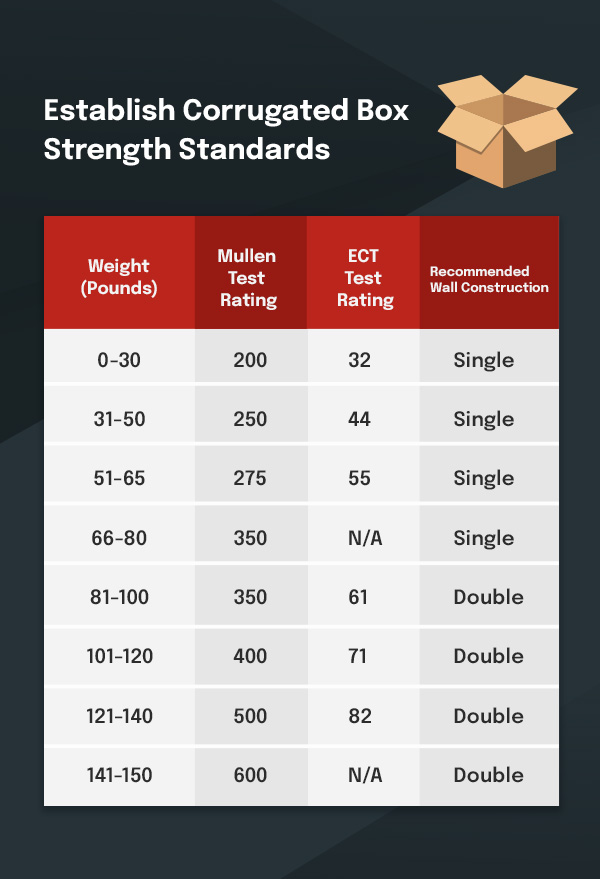
| Weight (Pounds) | Mullen Test Rating | ECT Test Rating | Recommended Wall Construction |
| 0-30 | 200 | 32 | Single |
| 31-50 | 250 | 44 | Single |
| 51-65 | 275 | 55 | Single |
| 66-80 | 350 | N/A — Mullen rating is typically the primary indicator | Single |
| 81-100 | 350 | 61 | Double |
| 101-120 | 400 | 71 | Double |
| 121-140 | 500 | 82 | Double |
| 141-150 | 600 | N/A — Mullen rating is typically the primary indicator | Double |
Each item’s length, width and height at the widest points will determine the correct size for a corrugated box. This approach helps you select corrugated boxes that provide adequate space for cushioning while minimizing excess interior volume.
Corrugated boxes that closely match the product dimensions help immobilize contents during transit and reduce the risk of crushing during shipping. Proper sizing also helps avoid dimensional-weight penalties, as carriers calculate shipping costs based on the actual weight or the dimensional weight, whichever is greater.
Following packaging best practices for corrugated box selection supports proper protection of fragile items while helping control freight costs across your distribution network.
Used corrugated boxes may appear identical to new ones, but their structural integrity has already been compromised. Each shipment weakens the corrugated material through repeated stress on the flutes and linerboards. Humidity exposure during storage and transit further degrades the paper fibers. Plus, previous tape removal can damage the outer liner.
A reused corrugated box that fails incurs several expenses, including:
It can also impact potential customer lifetime value (CLV), as 67% of customers will avoid buying from a business again after a negative return experience. Using a new, custom-sized corrugated box costs far less than the product and customer relationship it protects.
Proper cushioning creates a suspension system that prevents items from touching the walls of the box and absorbs impact. It helps keep products completely stationary throughout transit.
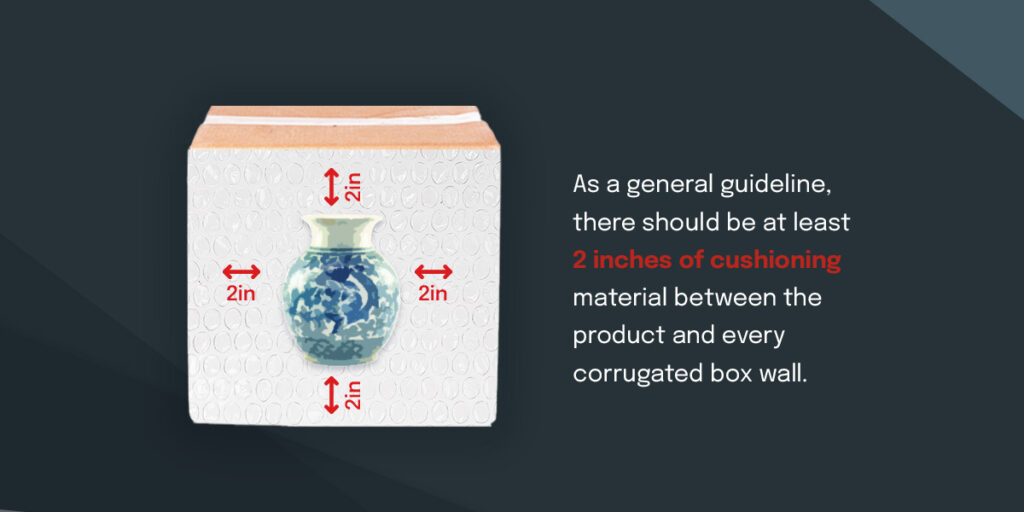
As a general guideline, there should be at least 2 inches of cushioning material between the product and every corrugated box wall. This space creates a protective buffer zone that helps the item better withstand the impacts, compression and vibration that occur during shipping.
However, the optimal amount of cushioning can vary based on the product’s fragility, weight and the specific cushioning material used. Highly fragile or heavy items may require more extensive cushioning or specialized packaging solutions. After packing, your team should gently shake the sealed corrugated box. If they hear or feel the product moving, it’s best to add more cushioning material.
Different cushioning materials serve different protective functions. Your procurement decisions should match material properties to the products’ vulnerability points and shipping conditions.
Combining materials often prevents shipping damage better than using a single cushioning type. Establish standard packing protocols, starting with corrugated pads to create rigid boundaries, wrapping fragile items in bubbled wrap and filling the remaining voids with air pillows or kraft paper.
Impact damage concentrates at edges and corners because these points make first contact during drops and collisions. Products with defined corners, such as framed items, electronics or corrugated boxes containing other boxes, need reinforced protection at these vulnerable points.
Options include:
Proper sealing helps maintain the corrugated box’s structural integrity throughout its journey. The H-taping method provides seal strength to prevent shipping damage.
Pressure-sensitive plastic tape provides the adhesive strength and tear resistance needed for shipping. It firmly adheres to corrugated surfaces and resists temperature changes and humidity that packages encounter during transit.
Several common tape types typically fail under shipping conditions and should be avoided:
The tape width matters too. Narrow tapes concentrate stress along a narrower bond line, increasing the likelihood of seal failure when corrugated boxes are subjected to rough handling.
The H-taping method reinforces all critical stress points where flaps meet. It prevents flaps from separating under the weight of stacked corrugated boxes or the pressure of shifting contents.
Three strips of tape should be applied to both the top and bottom of each box. One strip runs down the center seam where flaps meet, while the two other strips cross the edge seams where side flaps join the top flaps. The center strip helps prevent the main seam from opening, while the cross strips lock flaps together and reinforce corners where stress concentrates.
Heavy packages or shipments traveling long distances benefit from additional reinforcement. A perimeter tape band applied completely around the corrugated box at the seam line acts as a structural belt, holding the package together even if individual strips begin to fail.

Clear, properly placed shipping labels enable carriers to route packages efficiently through logistics management systems, supporting on-time delivery and customer satisfaction.
Shipping labels belong on the largest, flattest surface of the corrugated box. This placement provides maximum visibility for both automated scanning systems and human handlers. The top surface of the corrugated box typically offers the best location. If this isn’t possible, use the longest side panel.
Establish labeling protocols that avoid these common placement issues:
Corrugated boxes scraping against conveyor belts, packages sliding against each other in trucks, and exposure to the elements during loading can all render exterior labels unreadable. When carriers can’t identify a package’s destination, it enters exception processing. This can delay delivery by days or weeks.
A simple backup system helps prevent this problem. A duplicate shipping label should be placed inside the package before each box is sealed, affixed to the interior of the top flap or to the product’s outer packaging. If the exterior label becomes damaged or detached, carriers can open the package, locate the duplicate label and continue delivery.
Your packaging protocols should also include placing a return address inside each package. If both labels become damaged and the carrier must return the package, this interior information ensures it reaches your facility rather than entering the lost package processing system. For high-value shipments, a printed packing slip with full address details for both the sender and recipient can help minimize handling delays.

The right-sized, right-strength corrugated box is the first step to reducing shipping damage. Every other protective measure depends on the structural integrity of the primary container.
Custom Boxes Now has been engineering corrugated boxes tailored to product dimensions and shipping requirements for more than 60 years. Our facility can assist with structural design and choosing between printing methods. We proudly maintain an over 99% on-time delivery rate and hold International Organization for Standardization (ISO) 9001:2015 certification for quality management.
Use our online box builder tool to start exploring options, or contact our team today. We’ll guide you through selecting the specifications that best protect your products during shipping.

