
Shipping books as a commercial business takes strategy and research. You want your merchandise to arrive safely and exceed your customers’ expectations, and this means books should arrive quickly and in pristine condition. However, you’d also like a shipping service that benefits your business directly — it should be affordable and incorporate branded packaging.
The packaging and shipping partners you choose will impact your company’s reputation. Packaging must protect books from damage or moisture, and shipping should provide reliable tracking information so that you know where your products are at all times. Working with a custom packaging company can help your books stay safe throughout their shipping journey, regardless of their unique size and weight.
In this guide, we’ll cover how to ship books cheaply and how to pack books for shipping. We’ll discuss popular book shipping carriers and compare their pros and cons. We’ll also cover tips for how to package different kinds of books for shipping. Then, you’ll be equipped to decide on the best packaging and shipping solutions for your books.
Books are heavy, so shipping them in bulk can get expensive. The best shipping option for your commercial business depends on factors like:
Options for affordable bulk book shipping include United States Postal Service (USPS) Media Mail. Options like USPS Priority Mail, UPS Ground and FedEx Ground can also be cost-effective, depending on your situation. Here’s a quick comparison of carrier pros and cons to help you decide which option will work best for you.
Commonly regarded as the cheapest way to ship books in bulk, USPS Media Mail is a discounted USPS service for eligible media like books. Here’s a quick overview of how it works:
If you don’t mind a flexible delivery speed, this is the most cost-effective shipping option for books. Books with at least eight printed pages are eligible for this kind of shipping, and you’ll receive USPS tracking information on all shipped products. However, keep in mind that any printed media with advertising is not allowed, and USPS may open your boxes for inspection.
Another good option for shipping books in bulk, this USPS service offers expedited shipping for general merchandise. USPS Priority Mail offers several options for everything from light shipments to heavy cartons. Here’s what you can expect when working with USPS Priority Mail:
You should consider this shipping option if you need faster shipping. There are several categories to choose from, depending on your parcel’s weight — USPS Priority Mail is great for light to medium-weight parcels, while USPS Priority Mail Cubic is a good option for small, dense boxes. This option is priced by the outer volume tier instead of the parcel’s weight.
UPS Ground is another solid choice for shipping books commercially. If you’re shipping large, heavy cartons and need day-definite estimates, this is an ideal option. UPS Ground handles commercial shipping with professionalism, offering tracking information and handling heavy boxes without damage. Here’s more about the logistics of working with UPS Ground:
UPS Ground can handle much heavier boxes than many other commercial shipping companies. It offers steady transit predictability on certain lanes and Hundredweight programs that can save you costs on bulk shipping.
FedEx Ground has similar strengths and benefits to working with UPS Ground. Shipping speed is the same, costs are similar, and both companies can handle heavy parcels. Whether you should choose UPS Ground or FedEx Ground depends on your specific contract, surcharges and shipping timeline. Here’s what working with FedEx Ground is like:
FedEx Ground may be the best choice if you need multipiece discounts or want later same-day pickups in your market. This option tends to price well for book cartons that hit their actual weight before their DIM, and you may receive earned discounts for heavier parcels with FedEx Ground.
In some cases, shipping books as parcels isn’t the best tool. When multiple cartons exceeding 200-300 pounds are heading to a single consignee, a pallet is often a more practical choice. Oversized boxes are also more safely shipped on a pallet. Pallet shipping uses the same boxes as parcel shipping, but they’re tightly wrapped with corner posts, top sheets and stretch wrap as a moisture barrier around all sides.
Shipping practices vary depending on the kind of books you’re sending. Some factors that affect how to package a book for shipping include the type of book binding and the number of books shipped. This means that the best packaging practices for your company depend on your product. Here’s more about how to ship specific kinds of books.
Comic books are more delicate than other kinds of books, so it’s essential to package them carefully. You can protect individual comic books by putting flat pieces of cardboard on either side of the book, then carefully wrapping the book in a plastic wrapper or stretch wrap. Place the wrapped comic book in a stiff-sided container and use void fill to prevent it from moving around when shipped.
When you ship multiple comic books at a time, pack them securely so that they won’t rub against each other. Make sure they have moisture protection and their corners are protected from damage inside the shipping box. You can place stiff cardboard at the top and bottom of an entire book stack and then tightly wrap it with stretch wrap.
Many comic books are valuable, so it’s extremely important that you wrap them well. Older comic books can’t be replaced, and a customer who cares about comics will be upset if the product they purchased is damaged beyond repair. It’s best to also choose a shipping carrier that offers tracking and insurance for valuable comic books.
When shipping hardbacks and paperbacks together, always put hardbacks in the bottom of the box. They’re heavier and shouldn’t be shifting on top of lighter-weight paperbacks. You can individually wrap hardbacks and paperbacks in stacks with stretch wrap and flat cardboard pieces, so the book edges and covers are more protected during travel.
You may find it more affordable to distribute weight between packages by mixing hardbacks and paperbacks in the same box for shipping. However, another way to reduce shipping costs is to ship heavier hardbacks through one carrier and lighter paperbacks through another. The right option for you depends on the size and frequency of your book shipments.
You need a strategy that balances product protection with affordable shipping costs. There are several steps you can take to ensure your books arrive safely without exceeding your shipping budget. Use these tips to achieve your goals and refine your shipping strategy.
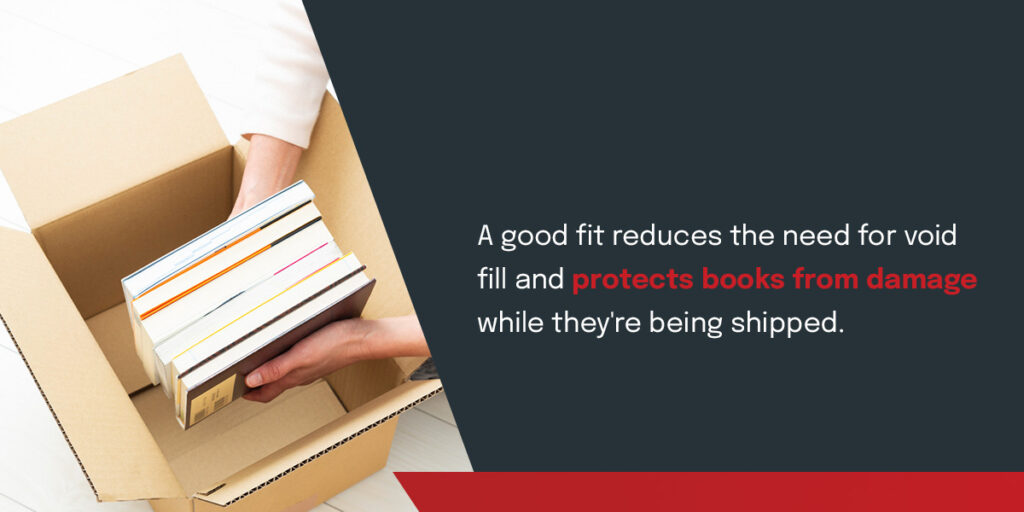
Make sure the boxes you use are the right size — not too big and not too small. A good fit reduces the need for void fill and protects books from damage while they’re being shipped. Overfilling boxes can damage products, too, so order boxes that are large enough for your products.
If you use oversized boxes, they can trigger DIM with some carriers. This category can cost more, so it’s best to avoid it unless you need to use it. You can simplify the process of choosing box sizes by creating a few standard box sizes for your product. These sizes can cover most orders, reducing shipping costs and the time it takes you to pack merchandise.
You don’t have to choose one single shipping carrier. For some orders, Media Mail may be the best solution. Large orders may be more cost-effective with UPS Ground shipping. Order size and time-sensitivity will help determine which shipping method is the best choice for that particular order.
You can create rules that let you know which option is the most cost-effective and customer-centered choice. Once these rules are in place, shipping books out will become much simpler. You will always know which carrier is the best option, and you can quickly ship orders through the appropriate means. Some packaging companies can work directly with shipping carriers, streamlining the shipping process even further.
As much as possible, you should consolidate multipiece shipments. Options like UPS Hundredweight or FedEx Multweight can lead to much lower shipping costs when you consolidate multibox orders into a single shipment. When it’s not possible to consolidate, choose the most cost-effective carrier for each shipment.
Although double-walled boxes are stronger, you might not need your boxes to be that strong. Take the time to design custom shipping boxes with minimal materials and maximum protection for your products. This process may take some experimentation, but it’s worth it for the long-term shipping costs. Remember that the heavier your boxes are, the more expensive shipping will be.
Books are a fragile type of merchandise. Torn dust jackets, damaged corners and folded pages can negatively impact your bottom line and reputation as a company. To ensure books reach their destination in mint condition, choose custom packaging that’s structurally sound and packed with void fill. Here are several things to consider when choosing custom packaging for books.
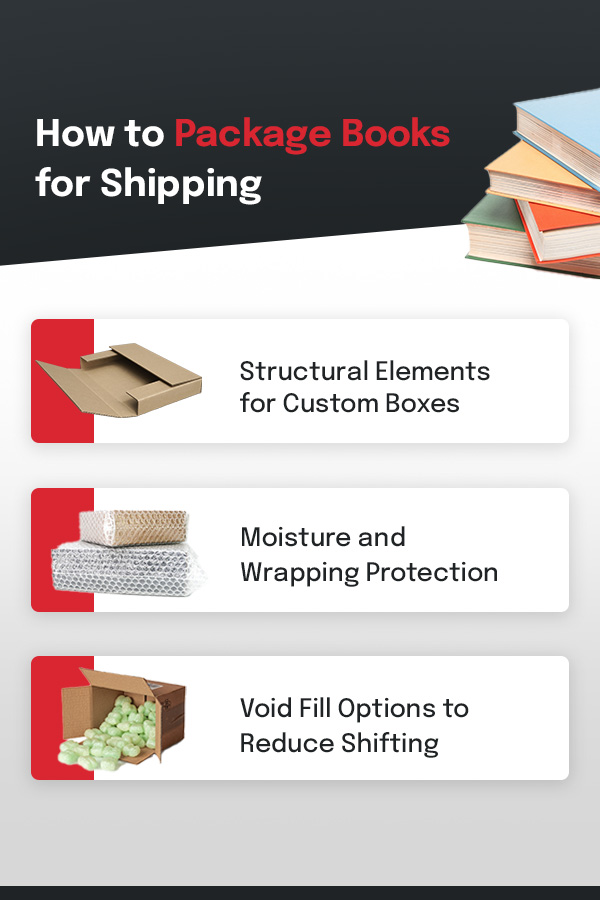
Boxes made of corrugated cardboard are a good option when you’re shipping large numbers of books. This material is eco-friendly and has enough structure to protect books from damage during transit. You can choose double-walled corrugated cardboard for an even stronger box to carry heavy books.
Custom boxes may allow you to include corner reinforcements and internal stabilizers for even more protection. With the proper construction, you can reduce common shipping damages like cover scratches, corner dents and spine breaks. The structure of your custom box creates a strong barrier that protects books from the outside world.
While corrugated cardboard is eco-friendly, it’s not waterproof. Especially for international shipments, it’s important to protect books from moisture with wrapping options like plastic bags and book sleeves. Other kinds of wrapping protection, like Bubble Wrap and acid-free tissue paper, can improve the unboxing experience and protect books in transit.
The best combination of wrapping materials depends on where your books are being shipped and who will receive them. Although wrapping may feel like an unnecessary cost, it can make all the difference when your customers open the boxes they’ve received from you. A little thoughtfulness goes a long way and shows you care about your merchandise arriving in the best possible shape.
Once inside the box, books can cause damage by shifting and rubbing against each other. To prevent this, you can carefully pack the box to reduce empty space. Remaining gaps should be filled with void fill, material like kraft paper that can be wedged between products to eliminate shifting.
While older void fill, like packing peanuts, isn’t good for the environment, modern options are more sustainable and effective. They include recycled paper, air pillows and custom inserts made of recycled material. These newer options are lightweight, so they don’t increase shipping costs.
Custom packaging can do more for your business than simply get books to their destinations. When you include custom graphics and branding, your packaging can help spread the word about your company’s values and reputation, one box at a time. Branded packages are more memorable and show that you care about your merchandise.
Benefits of branded packaging include:
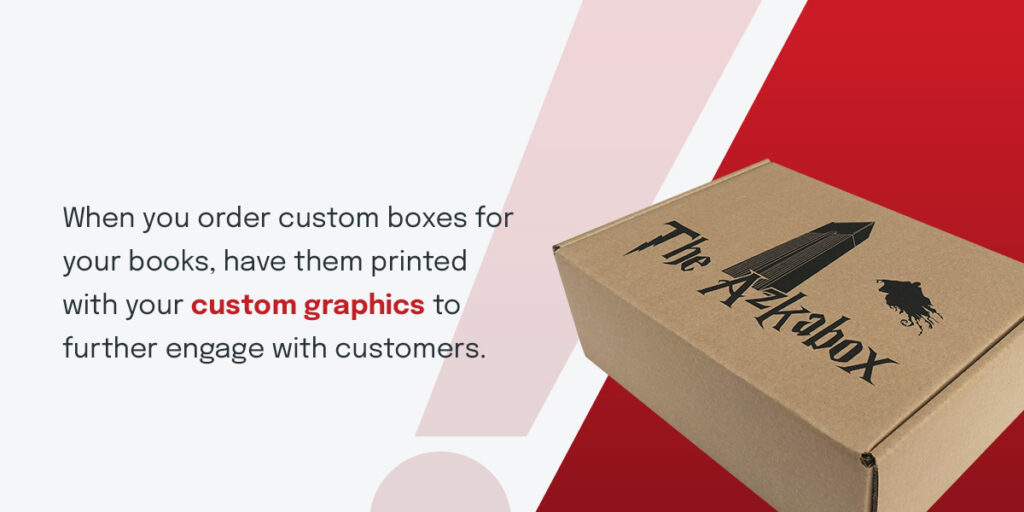
Practically, custom boxes make sense for fragile book shipments. From an aesthetic point of view, branding is the same way — it makes sense to use a product you’re already sending to customers to increase recognition for your company. When you order custom boxes for your books, have them printed with your custom graphics to further engage with customers.
Ideas for graphics include:
When customers receive your box, they’ll read it while they open it, and the extra touch of character will make your company stand out. Putting graphics and text on your packaging also helps you to connect with your target audience — the people who read your box and love it will find an instant connection with your company and want to continue that connection.
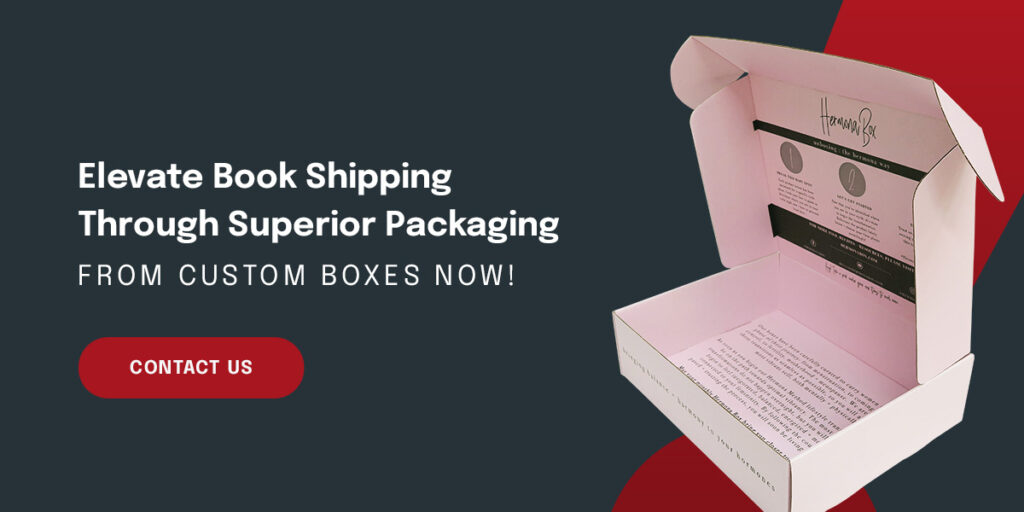
Custom Boxes Now! is your partner for custom shipping boxes designed to transport books commercially. Our custom shipping boxes offer maximum protection for your products, and our printed custom boxes ensure your branding is eye-catching for customers.
At Custom Boxes Now, we stand out because of our industry-leading lead times, pre-press expertise and structural design experience. We have over 60 years of experience in the box-making business and complete everything in-house, ensuring the highest quality product with every order. Our print capabilities include digital, flexo and litho, depending on your needs.
We offer many different sizes, shapes and options so you can build the ideal box for your product. Follow our easy online prompts to create your box, or contact our experts with any questions about your order. We look forward to supporting you with our quick delivery times and custom shipping box options!

